
From Boardroom to Playroom: How One Mother Built a Learning World Around Play
8 Jun 2026
Are you looking for Natural fibers then check out this post to know more. Fiber is a hair-like strand of material. It is flexible and can be spun or twisted for weaving, braiding, knotting, crocheting, etc to make desired products. Fibers can be obtained in natural form from plants and animals as well as in synthetic form. Man-made or synthetic fibers are either made up of chemicals or by processing natural fibers to create new fiber structures/properties. List of Natural fibers Types of natural

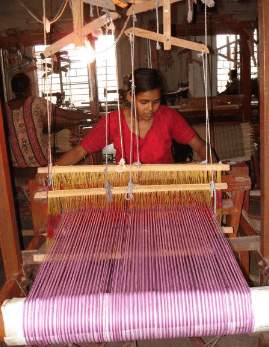
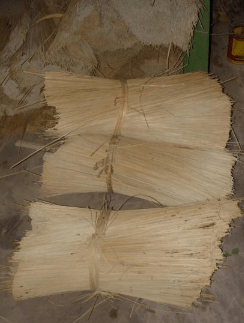 The raw materials are either procured through local collectors who are paid for supplying the material or from the local market.
•Dyes –natural dyes, direct dyes and vat dyes are used
•Yarn –undyed or dyed yarn, used for the warp
•Fabric –used for lining and piping
Tools
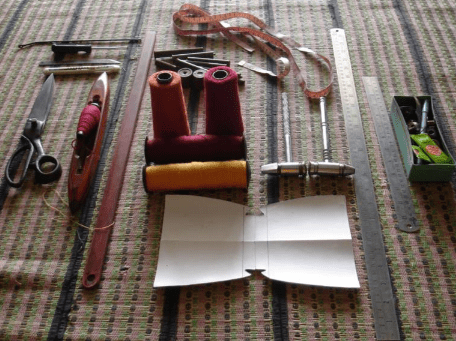
The basic tools are: frame loom, flat wooden stick with hole at one end (to help insert the grass in the weft), a sharp blade, scissors, ruler, measuring tape, cardboard template to cut the woven mat in desired shape and a sewing machine.
The raw materials are either procured through local collectors who are paid for supplying the material or from the local market.
•Dyes –natural dyes, direct dyes and vat dyes are used
•Yarn –undyed or dyed yarn, used for the warp
•Fabric –used for lining and piping
Tools
The basic tools are: frame loom, flat wooden stick with hole at one end (to help insert the grass in the weft), a sharp blade, scissors, ruler, measuring tape, cardboard template to cut the woven mat in desired shape and a sewing machine.
 Process
Madhurkati (a kind of grass) sticks are used for weaving mats in the areas mentioned. Sticks of longer length (about 56 inches) are used for making floor mats. They are first dyed. Natural as well as synthetic dyes can be used for the purpose. After the sticks have dried they are ready for the loom. The mats are woven on frame looms.
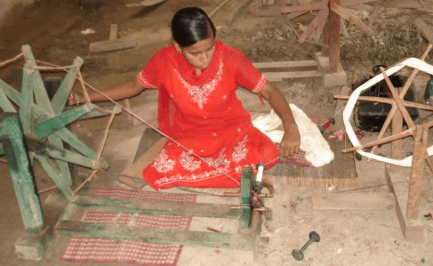
The warp can be plain undyed yarn purchased from the market or it can be dyed. After dyeing the yarn is opened or disentangled on the charkha and wound into small bundles. The next stage is warping, which takes place on a warping or taana machine, an octagonal cylinder-like frame. The thread rolls are first placed in a predetermined manner on a vertical frame. When the taana machine is rotated threads from these rolls pass through a reed frame and are wound on the cylinder, preparing the warp threads. Once the required length has been achieved the warp threads are transferred onto a beam on the loom for weaving.
The weft comprises of a combination of madhur sticks and dyed yarn. Sometimes only the natural fiber is used in the weft. They can also be combined with metallic yarn. The yarn is wound in bobbins.
Process
Madhurkati (a kind of grass) sticks are used for weaving mats in the areas mentioned. Sticks of longer length (about 56 inches) are used for making floor mats. They are first dyed. Natural as well as synthetic dyes can be used for the purpose. After the sticks have dried they are ready for the loom. The mats are woven on frame looms.
The warp can be plain undyed yarn purchased from the market or it can be dyed. After dyeing the yarn is opened or disentangled on the charkha and wound into small bundles. The next stage is warping, which takes place on a warping or taana machine, an octagonal cylinder-like frame. The thread rolls are first placed in a predetermined manner on a vertical frame. When the taana machine is rotated threads from these rolls pass through a reed frame and are wound on the cylinder, preparing the warp threads. Once the required length has been achieved the warp threads are transferred onto a beam on the loom for weaving.
The weft comprises of a combination of madhur sticks and dyed yarn. Sometimes only the natural fiber is used in the weft. They can also be combined with metallic yarn. The yarn is wound in bobbins.
 The beam with the warp thread is placed on one end of the loom while the weaver sits at the other end at the level of the loom, with feet placed over the pedals or treadle. With the pressing of the treadles the warp threads open through the ruchh (vertical cords with an eye through which the thread passes). With one hand the weaver takes the hand-shuttle across the warp to fill in the weft yarn. The madhur sticks are filled in across the warp threads using a flat wooden rod with a hole at one end. The grass stick is inserted through the hole and stretched across the warp yarn with the flat wooden bar. The beater with reed (comb-like frame) is drawn with the other hand to beat the weft firmly into the warp. The movements are repeated to weave the desired mat. As the mat is woven, it is wound onto abeam placed near the foot of the weaver.
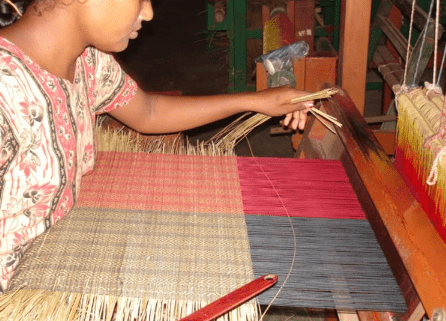 Once the weaving is complete the mat is taken off the loom. The edges are cut off evenly and secured with fabric borders.
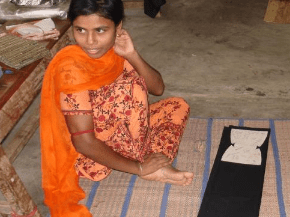
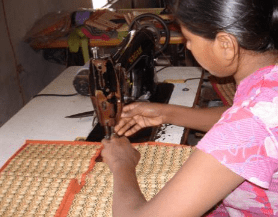 Different products like curtains, wallets, pouches, mobile holders, etc are made using the woven mat material. The material is cut out using cardboard templates. It is lined with cotton fabric that is pasted on it using gum. The edges are secured with fabric borders. Stitching is done on the sewing machine.
Products and Their Uses
A wide variety of products is made: floor mats, beach mats, table mats, table runners, coasters, curtains, cushion covers, bolster covers, floor cushions, furniture, shoulder bags, purses, coin purses, wallets, magazine holders, cutlery trays, fruit trays, boxes, bins, and baskets.
Changes in Recent Years
Market
The market for natural fiber products has seen an upward trend in recent times. While jute and silk have for a long time held a major share of the market in natural fibers, products made out of banana fiber, sisal, palm leaf, coir, screw pine, grass, etc are also gaining popularity in the contemporary market. A lot of product diversification has taken place in natural fiber crafts. Industries, an organization based in Bangalore working exclusively in natural fiber crafts, has contributed significantly to this product diversification and in introducing lesser known natural fiber crafts in contemporary spaces.
Design
Design development has been noticeable in natural fiber crafts. A variety of products are being made to suit contemporary spaces. While floor mats and baskets have traditionally been made they are now available in bright colors and attractive color combinations. Industries’ range of innovative natural fiber products includes cushions made of screw pine and banana fiber, furniture in innovative designs, lamps, storage products, and table ware and personal accessories. Child and Welfare Society (CSW) working with about 300 women in West Bengal, is also involved in upgrading its product range. The region is rich in natural fibers. People here have traditionally been weaving mats and baskets. Efforts are being made to upgrade their skills and product range through various workshops.
Technology
A variety of natural fibers is available in abundance in several parts of the country, and thus the scope of crafts based on these is huge. Technological up gradation in some processes has led to greater efficiency. An example is the ratt machine, a simple devise for twisting fiber into yarn or rope. Such technological up-gradations are required to make natural fiber products competitive in the market.
Different products like curtains, wallets, pouches, mobile holders, etc are made using the woven mat material. The material is cut out using cardboard templates. It is lined with cotton fabric that is pasted on it using gum. The edges are secured with fabric borders. Stitching is done on the sewing machine.
Products and Their Uses
A wide variety of products is made: floor mats, beach mats, table mats, table runners, coasters, curtains, cushion covers, bolster covers, floor cushions, furniture, shoulder bags, purses, coin purses, wallets, magazine holders, cutlery trays, fruit trays, boxes, bins, and baskets.
Changes in Recent Years
Market
The market for natural fiber products has seen an upward trend in recent times. While jute and silk have for a long time held a major share of the market in natural fibers, products made out of banana fiber, sisal, palm leaf, coir, screw pine, grass, etc are also gaining popularity in the contemporary market. A lot of product diversification has taken place in natural fiber crafts. Industries, an organization based in Bangalore working exclusively in natural fiber crafts, has contributed significantly to this product diversification and in introducing lesser known natural fiber crafts in contemporary spaces.
Design
Design development has been noticeable in natural fiber crafts. A variety of products are being made to suit contemporary spaces. While floor mats and baskets have traditionally been made they are now available in bright colors and attractive color combinations. Industries’ range of innovative natural fiber products includes cushions made of screw pine and banana fiber, furniture in innovative designs, lamps, storage products, and table ware and personal accessories. Child and Welfare Society (CSW) working with about 300 women in West Bengal, is also involved in upgrading its product range. The region is rich in natural fibers. People here have traditionally been weaving mats and baskets. Efforts are being made to upgrade their skills and product range through various workshops.
Technology
A variety of natural fibers is available in abundance in several parts of the country, and thus the scope of crafts based on these is huge. Technological up gradation in some processes has led to greater efficiency. An example is the ratt machine, a simple devise for twisting fiber into yarn or rope. Such technological up-gradations are required to make natural fiber products competitive in the market.Get Swadesi News in your inbox
Top stories, mandi prices, weather alerts — once a day, in English. Free, no spam.
8 Jun 2026

6 Jun 2026

4 Jun 2026

4 Jun 2026